
 Facebook
 X
 Pinterest
 Copy Link
Why Are Some Auburn and Opelika Homes Sitting on the Market?
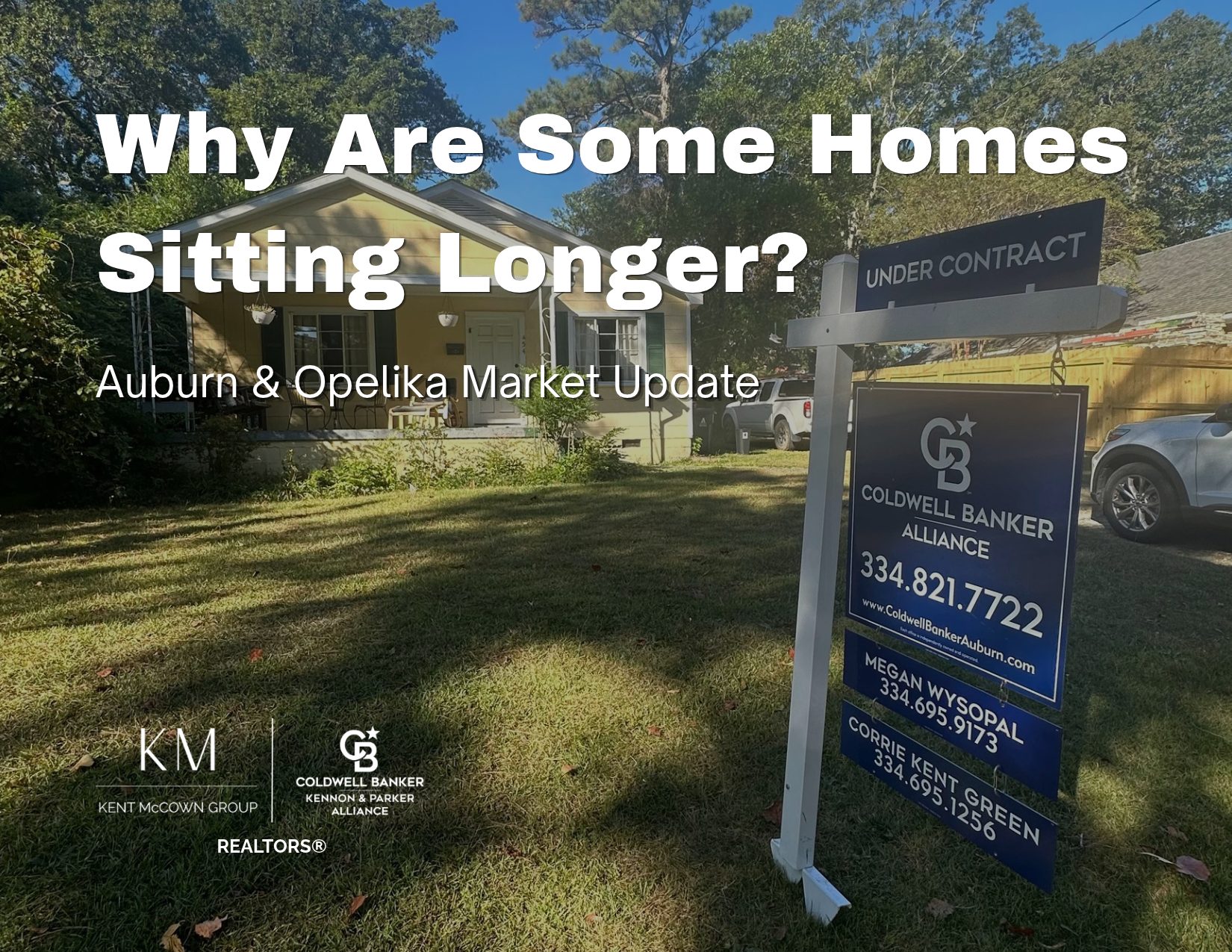
Why Are Some Auburn and Opelika Homes Sitting on the Market?
The Auburn Opelika housing market has more available homes than it did one year ago. Buyers are still purchasing, but inventory has grown faster than sales. With more options to compare, buyers can be more selective about price, condition and overall value, causing some homes to sit longer.
Some homes are sitting on the market in Auburn and Opelika because inventory has grown faster than buyer demand. Buyers are still purchasing homes, but they have more options and can be more selective about price, condition and overall value. A home that does not compare well with its competition may take longer to attract an offer.
What Is Happening in the Auburn and Opelika Real Estate Market?
The October 2026 housing report from the Lee County Association of REALTORS® shows that buyers have considerably more choices than they did one year ago.
Across Lee County, the number of residential properties on the market increased from 600 in October 2025 to 838 in October 2026. That is an increase of approximately 40%.
Sales increased too, but at a much slower rate. Residential sales rose from 152 to 167, an increase of 9.9%.
This does not mean homes are not selling. It means the supply of available homes grew much faster than the number of completed sales. More listings are competing for the attention of each buyer.
Average days on market increased from 55 to 68 days across Lee County, a 23.6% year-over-year increase.
Are Homes Taking Longer to Sell in Both Auburn and Opelika?
Yes, although the numbers look different in each city.
Auburn had 441 residential properties on the market in October 2026, compared with 282 one year earlier. That represents a 56.4% increase in available inventory. Auburn sales also increased from 72 to 93, while average days on market rose from 58 to 62 days.
Opelika had 262 residential properties on the market, compared with 216 in October 2025. Sales increased only slightly, from 47 to 48, while average days on market rose from 53 to 66 days.
The Opelika numbers show the challenge clearly. Buyers had 21.3% more homes to consider, but the number of completed sales increased by only 2.1%.
Are Existing Homes Really Sitting Longer?
Not all property categories are moving at the same pace.
According to the October report, existing homes across Lee County averaged 52 days on market in both 2025 and 2026. New construction increased from an average of 60 days to 91 days.
This means much of the increase in the overall average came from new construction. It also means sellers should not assume every home will automatically take 68 days to sell.
Property type, price range, location, condition and competition all matter. A well-positioned existing home may sell much faster than the countywide average, while a home that enters the market at the wrong price may take considerably longer.
Why Do Some Existing Homes Sit on the Market?
1. The Price Does Not Match the Condition
Price and condition cannot be evaluated separately.
The National Association of REALTORS®’ guide to pricing a home explains that property condition, current competition and recent comparable sales should all help shape a home’s asking price.
A home does not have to be fully renovated to sell, but its price must reflect the work a buyer believes it needs. When buyers see dated finishes, deferred maintenance or visible repairs, they begin estimating how much money and effort they will need after closing.
If a move-in-ready home is available at a similar price, the home needing work may be passed over.
2. Buyers Have Better Options
When inventory increases, buyers can compare more homes within the same price range.
They are looking at location, square footage, updates, lot size, monthly payment and expected repair costs. A listing does not compete only against recently sold homes. It also competes against every similar home currently available.
That is why active listings are an important part of determining the right asking price.
3. The Home Does Not Make a Strong First Impression
Most buyers see a home online before deciding whether to schedule a showing.
NAR’s consumer guide to marketing a home also identifies cleaning, decluttering, staging, professional photography and curb appeal as important parts of preparing a home for buyers.
Dark photographs, crowded rooms, visible repairs or an unclear listing description can cause buyers to keep scrolling. Staging, professional photography, a floor plan and thoughtful property details help buyers understand the home before they visit.
Marketing cannot hide an unrealistic price, but strong presentation helps buyers recognize a home’s value.
4. Early Buyer Feedback Is Being Ignored
The first few weeks on the market provide valuable information.
A home receiving online attention but few showings may have a presentation or pricing problem. A home receiving showings but no offers may not compare well once buyers see it in person.
Repeated feedback about the same issue should be taken seriously. The market is often telling the seller what needs to change.
A Real Opelika Example
We are currently marketing a single-family ranch home in Opelika that has been on the market for more than 100 days.
Buyer feedback and market activity indicate that the home’s original price did not align with its condition. Buyers were comparing it with other available homes and deciding that the updates and repairs it needed were not reflected strongly enough in the asking price.
We recommended staging the home and completing strategic minor repairs and improvements. The property is still being marketed, so this is not a tidy before-and-after success story. It is a real example of what sellers are facing in the current market.
Sometimes the best strategy is not one dramatic change. It is a combination of improved presentation, necessary repairs, realistic pricing and continued exposure.
What Should Sellers Do if Their Home Is Not Selling?
Review the Competition
Look at homes that are currently active, pending and recently sold. Pay close attention to properties buyers may see as alternatives to yours.
Reevaluate the Price
A price reduction should be based on market evidence, not an arbitrary amount. Consider showing activity, feedback, competing listings and recent sales.
Address the Most Noticeable Problems
Sellers do not always need a full renovation. Fresh paint, repaired fixtures, improved lighting, updated landscaping and professional cleaning can change how buyers experience a home.
Improve the Presentation
Staging does not mean filling the home with expensive furniture. It means helping each room feel functional, spacious and easy for buyers to understand.
Make Showings Easy
Buyers may have several homes to see in a limited amount of time. Restrictive showing requirements can cause a property to be left off the list.
Adjust the Marketing
Updated photography, a clearer description, a floor plan, video, virtual staging or renewed advertising can help introduce the home to buyers who previously overlooked it.
Does a Longer Market Time Mean a Home Will Not Sell?
No. Longer market time does not automatically mean there is no buyer for the home.
It may mean the home needs a better price, stronger presentation, more exposure or additional time to reach the right buyer. The important thing is to evaluate the evidence and adjust when the market is consistently delivering the same message.
Homes are still selling in Auburn and Opelika. Lee County recorded more residential sales in October 2026 than it did in October 2025. Sellers simply face more competition for those buyers.
Frequently Asked Questions
Is Auburn or Opelika currently a buyer’s market?
Current inventory and market-time trends give buyers more choices and negotiating room than they had during the strongest seller’s markets. Conditions still vary by property type, location and price range.
How long does it take to sell a home in Auburn or Opelika?
In October 2026, residential properties averaged 62 days on market in Auburn and 66 days in Opelika. Existing homes across Lee County averaged 52 days. An individual home may sell faster or slower depending on its price, condition and competition.
Should I reduce my price if my home has not sold?
Not automatically. First review the number of showings, buyer feedback, online activity, competing listings and recent sales. If the evidence shows that buyers do not see enough value at the current price, a strategic adjustment may be appropriate.
Should I make repairs before lowering the price?
It depends on the repair and the seller’s goals. Smaller improvements may strengthen the home’s presentation, while larger projects may not provide a full return. The price should still reflect any work the buyer will need to complete.
Can staging help a home that has been sitting?
Staging can help buyers understand the size, purpose and potential of a room. It works best when combined with appropriate pricing, good photography and attention to visible maintenance issues.
Get a Strategy Based on Your Home
A countywide average cannot determine what one property is worth or how quickly it will sell. Your neighborhood, property type, condition, price range and competition all affect the answer.
If your Auburn or Opelika home has been sitting on the market, or you want to avoid that situation before listing, the Kent McCown Group can help you review the competition and build a strategy based on current local data.
Contact Corrie Green and Megan Wysopal with Kent McCown Group at Coldwell Banker Kennon & Parker Alliance to discuss your home and your goals.
Written by Corrie Green and Megan Wysopal, REALTORS® with Kent McCown Group at Coldwell Banker Kennon & Parker Alliance
Market statistics are based on the Lee County Association of REALTORS® October 2026 housing report and are deemed reliable but not guaranteed. Market conditions can change.
Fall Home Selling in Auburn and Opelika: 3 Things to Know

Fall Home Selling in Auburn and Opelika: 3 Things to Know
Fall home selling in Auburn and Opelika looks a little different than it does in many other markets. While real estate activity may slow down in some areas after summer, fall brings football weekends, returning alumni, visiting families and thousands of people into our community.
That doesn’t mean every football fan is looking for a house, but it does create opportunities for local listings to be seen by people who may already have a connection to the area.
Here are three things Auburn and Opelika homeowners should know about selling during the fall.
1. Buyers Have More Homes to Compare
The days of simply putting a home on the market and expecting multiple offers are no longer the norm for every property.
According to Zillow’s national fall market report, inventory has continued to increase, giving buyers more choices. We are seeing that same shift locally. Buyers are still purchasing homes, but they can afford to be more selective about price, condition and location.
That makes it important to price your home according to today’s market—not what a neighbor sold for during a stronger seller’s market or what you hope a buyer might pay.
A home that enters the market too high can lose attention during its first few weeks. Once buyers begin wondering why it has been sitting, even a later price reduction may not create the same excitement.
The goal is not to be the cheapest home. It is to make sure buyers can clearly see the value compared with the other homes they are considering.
2. Football Season Brings More Eyes to Auburn
Fall may technically be a slower season, but Auburn doesn’t exactly become quiet.
Jordan-Hare Stadium holds more than 88,000 people, and Auburn’s home football schedule brings alumni, parents, investors and visitors into town throughout the season. Many arrive before Saturday and stay through Sunday, giving them time to explore Auburn, Opelika and the surrounding communities.
Some visitors are simply here for the game. Others may be considering a future move, looking for housing for an Auburn student, exploring an investment property or thinking about purchasing a game-day home.
That makes fall an opportunity, but sellers still need the right strategy.
Game-day traffic can make showings difficult in certain parts of Auburn, especially close to campus. Depending on the property, it may make more sense to schedule showings before the weekend, offer flexible appointment times or plan an open house around, not during, the busiest game-day hours.
The increased number of people in town can help create exposure, but the home still needs strong marketing to reach the visitors who may actually be interested in buying.
3. Well-Priced, Well-Presented Homes Can Still Stand Out
A market with more inventory does not mean homes are not selling. It means buyers are paying closer attention to which homes offer the best combination of price, condition and presentation.
Professional photography, accurate property information and a thoughtful marketing plan matter even more when buyers have several listings open on their phones at the same time.
Fall also comes with a few seasonal considerations. Sellers should keep leaves cleared from walkways, make sure exterior lighting works as the days become shorter and avoid letting holiday decorations overwhelm the home in listing photos.
Inside, warm lighting, clean gathering spaces and a comfortable temperature can help a home feel welcoming. Buyers should be able to picture themselves spending the holidays there without feeling like they are walking through someone else’s holiday storage.
Showing flexibility is also important. Between football games, school schedules, travel and the holidays, buyers may have limited opportunities to visit. Making the home available when serious buyers are in town can make a meaningful difference.
Should You Wait Until Spring?
Not necessarily.
Spring may bring more buyers, but it usually brings more competing listings too. Fall buyers often have a specific reason for moving, such as a job change, family need, investment timeline or upcoming semester.
The right time to sell depends on your home, your goals and the competition within your particular price range. A well-prepared home with realistic pricing and strong marketing can still attract attention during football season and into the holidays.
If you are considering selling in Auburn, Opelika or the surrounding area, the Kent McCown Group can help you understand what buyers are seeing, how your home compares and whether listing this fall makes sense for you.
120 Years of Real Estate: What Has Changed…and What Hasn’t

120 Years of Real Estate: What Has Changed…and What Hasn’t
Real Estate Explained
Think about what buying a home looked like in 1906.
There was no Zillow. No scrolling through listing photos from the couch. No electronic signatures, virtual tours or text messages from your REALTOR® telling you, “They accepted your offer!”
In fact, much of what we now consider a normal part of buying or selling a home would have been unimaginable.
But people still needed homes.
They still moved for jobs. They got married, had children, built businesses, lost loved ones, started over and looked for places where they could build their lives.
And that may be the most interesting thing about looking back at 120 years of real estate.
Almost everything about the way we buy and sell homes has changed.
The reasons we call a place home really haven’t.
Coldwell Banker Started During a Time of Rebuilding
The Coldwell Banker story began in San Francisco in 1906, following the devastating earthquake and fires that changed the city forever.
Colbert Coldwell saw a community facing an enormous rebuilding effort and founded what would eventually become Coldwell Banker on principles of honesty, integrity and service.
It was a very different real estate industry from the one we know today.
And yet, 120 years later, those ideas still matter.
Because no matter how sophisticated the technology becomes, real estate ultimately involves something deeply personal: where people are going to live their lives.
120 Years of Real Estate Has Changed a LOT
Imagine telling a homebuyer in 1906 that someday they would carry a device in their pocket that could show them almost every home for sale in their area.
They could look through dozens of photos without leaving their couch.
They could tour a home virtually.
They could sign a contract from their phone while sitting at their child’s ballgame.
And their REALTOR® could send an offer across town, or across the country, in seconds.
The technology alone would probably sound like science fiction.
But technology isn’t the only thing that has changed.
Homes have changed.
Neighborhoods have changed.
Financing has changed.
Contracts have changed.
Marketing has changed.
The way buyers search has changed.
The amount of information consumers have available to them has changed dramatically.
In fact, the role of a REALTOR® has evolved as buyers and sellers have gained access to more information than ever before.
And even within the same market, some homes sell quickly while others sit…a topic we’ve explained before.
Additionally, sellers are constantly trying to decide which changes buyers actually care about and whether they should renovate before listing.”
The Market Has Changed More Than Once, Too
If you’ve spent any time around real estate lately, you’ve probably heard someone talk about how much “the market has changed.”
And they’re right.
But here’s the thing:
The market has always changed.
Over 120 years, real estate has experienced periods of rapid growth, recessions, housing shortages, building booms, high interest rates, low interest rates, buyer’s markets, seller’s markets and just about everything in between.
Whatever market we’re experiencing today isn’t permanent.
Neither was the one before it.
And the next one won’t be either.
That’s one reason experience and good guidance still matter. The tools may change, but people still need someone who can help them understand what those changes mean for their situation.
What Hasn’t Changed in 120 Years?
This is our favorite part.
Because behind all those market statistics, contracts, mortgage rates and home values are actual people.
And people still move for remarkably human reasons.
A couple needs more room because they’re expecting a baby.
Someone accepts a new job and moves to a city they’ve never called home before.
Parents realize the house that once felt too small suddenly feels awfully big after the kids leave.
Someone gets married.
Someone gets divorced.
Someone loses a spouse.
Someone wants to live closer to their grandchildren.
Someone buys their very first home and stands in an empty living room imagining where the furniture will go.
Someone sells the house where they raised their children and hands the keys to another family who will begin making memories there.
Those stories would have been recognizable in 1906.
They’re recognizable in 2026.
That’s the part of real estate that hasn’t changed.
Why We’re Still Proud to Be Coldwell Banker
There are plenty of places we could hang our real estate licenses.
We choose to proudly serve under the Coldwell Banker name.
Part of that is because there’s something meaningful about being connected to a company that has weathered 120 years of real estate—through changing markets, changing technology and generations of homeowners—while continuing to focus on helping people find their way home.
Today, Coldwell Banker has grown far beyond its beginnings in San Francisco, with affiliated agents around the world.
But for us, that big history becomes very local.
It’s the family buying a home in Auburn.
It’s the seller moving out of the house they’ve owned for 30 years in Opelika.
It’s the first-time buyer who isn’t quite sure where to begin.
It’s the family relocating to East Alabama who needs someone to teach them not only about houses, but about neighborhoods, schools, traffic, traditions and what it’s actually like to live here.
Those are the tiny pieces of a 120-year story that we get to be part of.
And that’s pretty special.
1906 Looked Very Different From 2026. Home Didn’t.
A house in 1906 probably didn’t have an open-concept kitchen, smart thermostat or Wi-Fi.
Nobody was checking their doorbell camera from vacation.
And we’re pretty confident nobody was arguing about whether gray flooring had finally gone out of style.
But home?
Home was where babies were brought home.
Where children grew up.
Where people gathered around the table.
Where birthdays were celebrated.
Where families grieved.
Where ordinary Tuesday nights happened.
Where people dreamed about what came next.
And 120 years later, it still is.
That’s why this anniversary feels worth celebrating to us.
Not simply because a real estate company has been around for 120 years.
But because behind those 120 years of real estate are 120 years of people finding home.
We’re proud to be one small part of that history.
And we’re even more excited about the stories that haven’t been written yet.
Happy 120th Birthday, Coldwell Banker.
Here’s to what’s next.
Kent McCown Group proudly serves buyers and sellers throughout Auburn, Opelika and East Alabama with Coldwell Banker Kennon & Parker Alliance. Whether you’re buying your first home, selling one filled with decades of memories or simply wondering what your next move might look like, we’re here to help you find your way home.
Where Does a REALTOR’s Commission Actually Go?

Where Does a REALTOR’s Commission Go?
When people hear that a home sold for $400,000, it’s easy to assume the REALTOR® just walked away with a huge paycheck.
I hear comments like this all the time:
“Wow! You must have made a fortune on that sale!”
The reality is…that’s almost never how it works.
One of the biggest misconceptions in real estate is that REALTORS® keep the entire commission. In reality, the money is negotiated, divided, and used to cover the many costs of running a real estate business.
Let’s pull back the curtain and take a look at where a REALTOR’s commission actually goes.
First Things First: REALTORS® Only Get Paid if the Transaction Closes
This surprises a lot of people.
Most REALTORS® don’t earn an hourly wage or salary.
We don’t get paid for:
- Showing homes
- Hosting open houses
- Writing offers
- Negotiating contracts
- Coordinating inspections
- Driving across town for showings
- Answering evening and weekend phone calls
- Solving last-minute problems before closing
If a transaction falls apart before closing, the REALTOR® has often invested dozens…or even hundreds…of hours without receiving any compensation.
That’s simply part of the business.
How Commission Works Today
Let’s use a simple example.
Imagine a home sells for $400,000.
When a seller lists their home, they negotiate and agree to a listing fee with their listing brokerage. That fee covers the professional services provided to market and sell the property.
The seller may also choose to offer compensation to a buyer’s broker, but they are not required to do so.
If a seller chooses not to offer buyer broker compensation, or offers less than what a buyer and their agent have agreed to, the buyer can ask the seller to contribute toward that compensation as part of the purchase offer. Just like the purchase price, repairs, or closing costs, buyer agent compensation can be negotiated during the transaction.
Every real estate transaction is unique.
Speaking of common misconceptions, you may also enjoy reading What Actually Stays with the House When You Sell?
Then the Commission Is Divided
Whether the compensation comes from the listing agreement, a negotiated seller concession, the buyer, or a combination of those sources, the money doesn’t simply go straight into one REALTOR®’s bank account.
Instead, the funds are distributed according to the agreements in place.
That often means the money is divided between:
- The listing brokerage
- The listing agent
- The buyer’s brokerage
- The buyer’s agent
Exactly how that distribution looks depends on the transaction and the agreements everyone has in place.
Where Does a REALTOR’s Commission Actually Go?
Let’s imagine a REALTOR®’s brokerage receives $12,000 in compensation from a transaction.
Many people assume that’s what the REALTOR® takes home.
In reality, that’s just the starting point.
Before an agent ever receives a paycheck, that money may be reduced by things like:
- Brokerage split
- Transaction fees
- Franchise or royalty fees (if applicable)
- Errors & Omissions (E&O) insurance
- MLS fees
- Local, state, and national REALTOR® association dues
- Licensing fees
- Continuing education
- Marketing and advertising
- Professional photography and videography
- Signs and lockboxes
- CRM and technology subscriptions
- Fuel and vehicle expenses
- Office expenses
- Self-employment taxes
- Health insurance
- Retirement savings
Most REALTORS® are independent contractors, meaning they pay these expenses themselves.
Like any small business owner, they’re responsible for investing back into their business so they can continue serving clients.
REALTORS® Don’t Have a Guaranteed Paycheck
Unlike many professions, REALTORS® don’t receive:
- Paid vacations
- Sick leave
- Employer-sponsored retirement plans
- Guaranteed weekly paychecks
Some months include several closings.
Other months may include none, even though the work never stopped.
That’s why REALTORS® spend so much time building relationships, continuing their education, marketing their business, and serving clients long before payday ever arrives.
So…Is It Worth It?
Absolutely.
Helping first-time buyers get the keys to their first home.
Helping growing families find more space.
Helping empty nesters start their next chapter.
Those moments are why so many REALTORS® love what they do.
Behind every successful closing are weeks…or sometimes months…of work that most people never see.
The Bottom Line
The next time you hear someone say,
“That REALTOR® made a fortune on one sale.”
Remember there’s much more happening behind the scenes.
Before a REALTOR® ever sees a paycheck, the compensation has often been negotiated, divided according to multiple agreements, and used to cover the many costs of operating a real estate business.
And perhaps the biggest misconception of all?
REALTORS® don’t get paid when they start working.
Most only get paid if they successfully make it to the closing table.
Have Questions?
Real estate has changed over the past few years, and there’s a lot of misinformation floating around.
If you have questions about how commissions work, buyer agreements, or the home buying and selling process, we’re always happy to help.
The more you understand, the more confident you’ll feel when it’s time to make your next move.
If you’re preparing to sell, you may also enjoy our article on Should You Renovate Before Selling Your Home?
So, Where Does a REALTOR’s Commission Go? “It depends.”
Should You Renovate Before Selling Your Home?

Real Estate Explained
Should You Renovate Before Selling Your Home?
If you’re thinking about selling your home, you’ve probably asked yourself one of the most common questions homeowners face:
“Should I renovate before I list my home?”
The honest answer?
It depends.
Some improvements can help your home sell faster and potentially for more money. Others may cost thousands of dollars without adding much value at all.
So, Before you start knocking down walls or replacing every countertop, here’s what you should know.
Start With the Simple Things
The best return on investment doesn’t always come from major renovations.
Sometimes, the biggest impact comes from making your home feel clean, well-maintained, and move-in ready.
A few simple updates like:
- Fresh paint
- Deep cleaning
- Touch-up landscaping
- Replacing burned-out light bulbs
- Decluttering
- Cleaning windows
can completely change a buyer’s first impression.
Many buyers aren’t looking for perfection, they’re looking for a home that has been well cared for.
Not Every Renovation Pays You Back
One of the biggest mistakes sellers make is assuming every dollar they spend will increase the value of their home.
Unfortunately, that’s not always how it works.
A $40,000 kitchen remodel doesn’t automatically increase your home’s value by $40,000.
In fact, some highly personalized upgrades may actually make it harder for buyers to picture themselves living there.
Instead of asking,
“What do I want?”
ask,
“What will today’s buyers appreciate?”
Every Neighborhood Is Different
The improvements that make sense for one home may not make sense for another.
For example:
A home in one neighborhood may need updated flooring to stay competitive.
Another neighborhood may place more value on outdoor living spaces.
In some cases, buyers expect fully updated homes.
In others, they expect to personalize the home themselves.
That’s why local market knowledge matters.
Focus on Repairs First
Before investing in cosmetic upgrades, make sure the basics are covered.
Buyers notice things like:
- Leaky faucets
- Damaged flooring
- Peeling paint
- Broken door handles
- Loose railings
- HVAC issues
Small maintenance items can create the impression that larger problems have been ignored.
Because of this, fixing these issues first often provides a better return than expensive cosmetic renovations.
Should You Renovate?
Here’s a simple guide.
Renovations that often pay off:
✔️ Fresh neutral paint
✔️ Updated lighting
✔️ Landscaping
✔️ Professional cleaning
✔️ Minor kitchen or bathroom updates
✔️ New hardware and fixtures
Renovations to think carefully about:
- Luxury kitchen remodels
- High-end appliances
- Removing walls
- Custom finishes
- Swimming pools
- Highly personalized upgrades
Every situation is different.
Talk to a REALTOR® Before You Spend the Money
One of the biggest advantages of working with a local REALTOR® is knowing where to invest and where not to.
Before spending thousands of dollars, ask an agent who understands your neighborhood and current buyer expectations.
Sometimes, spending $500 wisely can have a bigger impact than spending $20,000 in the wrong place.
The Bottom Line
Should you renovate before selling your home?
It depends.
The right improvements can absolutely help your home attract buyers and maximize its value.
The wrong improvements can cost time, money, and unnecessary stress.
Before starting your next project, let’s have a conversation about what makes the most sense for your home, your neighborhood, and your goals.
Sometimes the smartest renovation is knowing when not to renovate.
Why Some Homes Sell Fast… and Others Sit on the Market

Why Some Homes Sell Fast…and Others Sit on the Market.
Real Estate Explained
Every time a home sells in a weekend, people ask the same question:
“What made that house sell so fast?”
And every time a home sits on the market for weeks or even months, people assume the answer is simple.
“It must be overpriced.”
Sometimes that’s true.
But not always.
The truth is, there are usually several factors working together to determine how quickly a home sells.
I’ve watched homes that needed cosmetic updates receive multiple offers because they were priced well and marketed effectively. I’ve also seen beautifully updated homes sit on the market because they missed the mark on pricing or presentation.
Price Is Important… But It Isn’t Everything
Pricing is one of the biggest pieces of the puzzle.
A home that’s priced too high can scare buyers away before they ever schedule a showing.
But pricing isn’t just about picking a number that “sounds right.” It’s about understanding the local market, comparable sales, current competition, and buyer demand.
Sometimes pricing a home competitively creates more interest, more showings, and even multiple offers.
First Impressions Start Online
Today’s buyers usually see your home online before they ever step through the front door.
That means your listing photos matter…a lot.
Bright, professional photos can make a home feel inviting.
Dark, blurry, or poorly composed photos can cause buyers to scroll right past a perfectly wonderful house.
Your online listing is your home’s first showing.
Make it count.
Condition Matters
You don’t need a fully renovated kitchen to sell your home.
But buyers do notice the little things.
Fresh paint.
A clean entryway.
Well-maintained landscaping.
Working light bulbs.
Small improvements can help buyers focus on the home instead of a growing list of projects.
Timing Can Make a Difference
Spring is traditionally a busy season, but homes sell year-round.
In fact, selling in the fall can sometimes mean less competition because there are fewer homes on the market.
The “best” time to sell depends on your goals and your local market, not just the calendar.
Marketing Is More Than Putting a Sign in the Yard
A great home deserves great marketing.
Professional photography.
Thoughtful descriptions.
Social media exposure.
Targeted advertising.
Agent networking.
The more qualified buyers who see your home, the better your chances of finding the right one quickly.
Buyers Don’t Just Buy Houses
They buy possibilities.
If you’re beginning your home search, browse homes currently available in Auburn and Opelika.
They picture birthday parties in the backyard.
Coffee on the porch.
Holiday dinners around the table.
The homes that create an emotional connection are often the ones buyers remember long after the showing ends.
So… Why Do Some Homes Sell Faster?
It’s rarely because of just one thing.
Usually it’s a combination of:
- Pricing
- Presentation
- Marketing
- Timing
- Buyer demand
- Strategy
The good news?
Most of those things are within your control.
Selling a home isn’t about luck.
It’s about making thoughtful decisions before your home ever hits the market.
Whether you’re thinking about selling next month or next year, having a plan can make all the difference.
What Actually Stays With the House When You Buy It?

What Stays With the House When You Buy It?
Have you ever walked through a home and wondered, “Does that refrigerator come with it?” Or maybe you fell in love with a porch swing, a beautiful chandelier, or even a one-of-a-kind carousel horse in the backyard. What Stays With the House When You Buy It?
The answer might surprise you.
One of the biggest misconceptions in real estate is that everything you see during a showing automatically comes with the home. In reality, some items stay with the property, while others belong to the seller unless they’re specifically included in the purchase agreement.
Let’s break it down.
What Usually Stays
In general, anything considered a fixture stays with the home. A fixture is something that’s permanently attached to the property.
Common examples include:
- Built-in cabinets and shelving
- Light fixtures and ceiling fans
- Bathroom mirrors that are attached to the wall
- Window blinds or shades
- Built-in appliances like dishwashers and ovens
- Mailboxes
- Landscaping that is planted in the ground
These items are considered part of the property and are typically included in the sale unless the seller specifically excludes them.
What Usually Doesn’t Stay
Personal property belongs to the seller and usually moves with them.
This often includes:
- Furniture
- Televisions
- Rugs
- Artwork
- Patio furniture
- Grills
- Potted plants
- Decorative mirrors that are simply hung on a nail
Even if an item looks like it “belongs” with the home, that doesn’t necessarily mean it’s included.
The Gray Areas
This is where things can get interesting.
Items like these often create questions:
- Refrigerators
- Washers and dryers
- Security cameras
- Porch swings
- Playsets
- Sheds
- Mounted televisions
- TV wall mounts
- Hot tubs
- Garage shelving
Some sellers plan to leave them. Others intend to take them.
The only way to know is to ask.
What If You Love Something Unique?
Maybe it’s a custom-built dining table that fits the breakfast nook perfectly.
Maybe it’s the porch swing where you can already picture yourself drinking coffee.
Or maybe it’s a vintage carousel horse sitting proudly in the backyard.
If it makes the property feel like home, don’t be afraid to ask if it can stay.
The seller may say no, but they might also be perfectly happy to leave it behind. Sometimes they don’t want the hassle of moving it, and sometimes they’re simply willing to include it as part of the negotiation.
You never know unless you ask.
The Most Important Rule
Real estate contracts are designed to eliminate assumptions.
If you want something to stay, it should be written into the purchase agreement.
If the seller plans to take something that buyers might reasonably expect to remain, that should be clearly stated as well.
Clear expectations help prevent misunderstandings and keep everyone on the same page.
Before writing an offer, it’s important to make sure everything you want to stay (or not stay) be discussed with your agent. This also will help determine what a great offer looks like.
Final Thoughts
If you’re just beginning your search, you can browse homes currently available in the Auburn and Opelika area.
Buying a home isn’t just about four walls and a roof. Sometimes it’s the little details that make you fall in love with a property.
Whether it’s a refrigerator, a porch swing, or a carousel horse, remember this simple rule:
If you want it, ask for it. If it’s important to either party, put it in writing.
Because when it comes to real estate, clarity is always better than assumptions.
Have questions about what should be included in your offer? We’d be happy to help.
Why Price Per Square Foot Can Be One of the Most Misleading Numbers in Real Estate

Price Per Square Foot – The Most Misunderstood Number In Real Estate
Helping buyers and sellers across East Alabama understand real estate, one question at a time.
“What’s the price per square foot in my neighborhood?”
As Realtors®, this is one of the most common questions we get from homeowners.
It’s an understandable question. Price per square foot is easy to find online, it’s often mentioned in market reports, and it seems like a quick way to estimate what a home might be worth.
In fact, many sellers become attached to that number before we ever sit down to discuss pricing.
The problem is that relying too heavily on price per square foot can create unrealistic expectations. In today’s market, pricing a home based on a simple calculation instead of its true market value can lead to fewer showings, lower offers, and ultimately more time on the market.
Before we talk about why, it’s important to understand what price per square foot actually tells us…and what it doesn’t.
What Is Price Per Square Foot?
Price per square foot is exactly what it sounds like. You take the sale price of a home and divide it by its finished square footage.
For example:
- A home that sells for $400,000 with 2,000 square feet sold for $200 per square foot.
It’s a useful statistic because it helps identify general trends in a neighborhood or local market.
The key word, however, is general.
It’s a market indicator, not a pricing formula.
No Two Homes Are Truly the Same
Imagine two homes that are both 2,000 square feet.
One backs up to a golf course.
The other sits on a busy road.
One has a beautifully renovated kitchen with custom cabinetry and quartz countertops.
The other still has its original finishes from twenty years ago.
One has a screened porch overlooking a private backyard.
The other has no outdoor living space at all.
Even though they’re exactly the same size, they are unlikely to sell for the same price.
Square footage is only one piece of the puzzle.
Smaller Homes Often Have a Higher Price Per Square Foot
This surprises many homeowners.
A 1,400-square-foot home may actually sell for a higher price per square foot than a 3,200-square-foot home in the very same neighborhood.
Why?
Because certain parts of every home carry significant value regardless of size.
Think about the kitchen.
Bathrooms.
The garage.
The roof.
The HVAC system.
The lot itself.
Those costs don’t double simply because the house is larger. Since those fixed-value features are spread across fewer square feet in a smaller home, the price per square foot is often higher.
That’s completely normal.
Buyers Don’t Shop With Calculators (Well, Most buyers anyway)
When buyers walk through a home, they aren’t thinking:
“This feels like exactly $212 per square foot.”
Instead, they’re asking themselves questions like:
- Can I picture my family living here?
- Is the kitchen updated?
- Do I love the backyard?
- Is there enough storage?
- Does the layout work for our lifestyle?
- Is this home worth the asking price compared to others I’ve seen?
Those emotional and practical decisions influence value far more than a simple mathematical formula.
Location Can Change Everything
You’ve probably heard the phrase:
Location, location, location.
There’s a reason it’s still one of the biggest factors in real estate.
Two nearly identical homes can have very different values simply because of where they’re located.
Things like:
- Neighborhood demand
- School districts
- Privacy
- Lot size
- Views
- Nearby amenities
- Traffic patterns
- Future development
all influence what buyers are willing to pay.
That’s true whether the home is in Auburn, Opelika, or one of the many wonderful communities throughout East Alabama.
Appraisers Don’t Use Price Per Square Foot Alone
One of the biggest misconceptions is that appraisers determine value by multiplying square footage by a dollar amount.
They don’t.
Professional appraisers compare similar homes that have recently sold and then make adjustments for differences such as:
- Size
- Age
- Condition
- Updates
- Lot characteristics
- Garages
- Pools
- Outdoor living spaces
- Overall appeal
This process creates a much more accurate picture of a home’s market value than a simple price-per-square-foot calculation ever could.
So… Is Price Per Square Foot Useless?
Not at all.
It’s actually a valuable tool when it’s used correctly.
Real estate professionals use price per square foot to identify market trends and compare similar properties.
The problem comes when it’s treated as the only factor in determining value.
Every home has its own story.
Every neighborhood is different.
Every buyer values different features.
That’s why pricing a home is both a science and an art.
The Bottom Line
Pricing a home isn’t about finding a magic number and multiplying it by the square footage.
It’s about understanding how buyers see your home in today’s market.
A well-priced home often attracts more interest, generates stronger offers, and creates a smoother selling experience.
On the other hand, pricing too high because of an oversimplified price-per-square-foot calculation can cause a home to sit on the market longer than necessary. As time passes, buyers naturally begin to wonder why it hasn’t sold, and that can make achieving your desired price even more challenging.
That’s why I prepare a Comparative Market Analysis (CMA) for every seller. A CMA looks beyond square footage to evaluate the things buyers actually pay for—location, condition, updates, amenities, lot characteristics, and recent comparable sales.
Our goal isn’t simply to tell you what your home is worth.
Our goal is to help you price it strategically so you can attract the right buyers and maximize your opportunity in today’s market.
Have a question you’d like us to explain?
Send it our way! Your question could inspire a future edition of Real Estate Explained. Whether you’re buying, selling, investing, or simply curious about the market in East Alabama, we’re here to help.
Alabama Housing Market Update | What Buyers & Sellers Need to Know This Summer

Alabama Real Estate Market Update
What the Latest Data Means for Buyers & Sellers This Summer
As we head into the second half of 2026, one question keeps coming up:
“How’s the market?”
The latest statewide data from Alabama REALTORS® gives us a good snapshot of where things stand. While these numbers reflect the most recent statewide report available, they help paint the bigger picture of what’s happening across Alabama and how those trends compare to what we’re seeing here in the Auburn-Opelika area.
Here’s what stands out.
Home Prices Continue to Rise
According to the latest Alabama REALTORS® report, the statewide median home price is $263,518, up 15.2% compared to the same time last year. Year-to-date, median home prices have increased 18.2%, showing that home values continue to appreciate across the state.
For homeowners, that’s welcome news.
If you’ve owned your home for several years, there’s a good chance you’ve built more equity than you realize.
Find out what your home is worth.
Buyers Are Still Buying in the Alabama Real Estate Market
Despite higher mortgage rates, buyers haven’t disappeared.
The latest statewide report shows more than $1.8 billion in residential home sales, an increase of nearly 20% compared to the previous year.
That tells us one important thing:
People are still buying homes.
They’re simply taking a little more time, asking more questions, and making thoughtful decisions before writing an offer.
Inventory Is Giving Buyers More Choices
One of the biggest shifts we’ve seen this year is inventory.
Alabama’s housing supply has grown to 4.8 months, giving buyers more homes to choose from than they’ve had in several years.
For buyers, that’s great news.
Instead of feeling pressured to make an offer within hours, many buyers now have the opportunity to compare homes, negotiate terms, and make confident decisions.
For sellers, it means pricing your home correctly is more important than ever. Buyers have options, and the homes that are priced well and show beautifully continue to attract the most attention.
Mortgage Rates Continue to Fluctuate
Mortgage rates remain one of the biggest topics in real estate conversations.
The average 30-year fixed mortgage rate has stayed above 6%, causing some buyers to pause, but not necessarily stop looking.
Life doesn’t wait for interest rates.
People still get married, grow their families, relocate for work, downsize, and invest in real estate. Those life changes continue to drive the housing market.
First-time homebuyer resources
What We’re Seeing Here in Lee County
Statewide reports are helpful, but real estate is always local.
Here in Auburn, Opelika, and the surrounding Lee County area, we’re seeing many of these same trends. Well-priced homes continue to attract strong interest, while buyers have a little more breathing room than they did just a couple of years ago.
Homes that are updated, well-maintained, and priced appropriately are still selling. Homes that are overpriced or need significant work are taking a little longer.
The market isn’t “hot” or “cold.”
It’s becoming more balanced, and that’s creating opportunities for both buyers and sellers.
Should You Wait?
I get asked this question almost every week.
The truth is, there’s rarely a “perfect” time to buy or sell.
The best time is when it makes sense for your family, your finances, and your goals.
Whether you’re thinking about upsizing, downsizing, investing, or simply wondering what your home could sell for, having the right information makes all the difference.
If you’re curious about today’s market or want to know what your home might be worth, I’d love to help.
No pressure. Just honest advice.
Thinking about buying or selling in Auburn, Opelika, or anywhere in Lee County? Let’s talk about your goals and create a plan that’s right for you. The market may have changed, but opportunities are still out there. Contact Kent McCown Group Now!
Are Rising Interest Rates Affecting Your Buyer Pool in Auburn & Opelika?

Are Rising Interest Rates Affecting Your Buyer Pool in Auburn & Opelika?
It’s one of the most common questions we’re hearing right now:
“Are interest rates shrinking my buyer pool?”
The short answer?
Yes… but maybe not in the way you think.
What Rising Rates Actually Do
When interest rates go up, buying power shifts.
Buyers who were comfortable at one price point may need to adjust their expectations (or their budget) slightly.
That doesn’t mean they disappear.
It just means they become more intentional.
What We’re Seeing Locally
Here in Auburn and Opelika, we’re still seeing strong activity, but buyers are paying closer attention.
They’re asking:
- Is this home priced correctly?
- Does it feel worth it compared to others?
- Am I going to be comfortable with this payment long-term?
Homes that are well-priced and well-presented are still moving.
Homes that aren’t… tend to sit a little longer than they used to.
It’s Not Just About Price, It’s About Perception
When rates rise, buyers become more selective.
That means things like:
- condition
- layout
- curb appeal
- overall presentation
matter even more than they did before.
If a home feels right, buyers will still move forward.
If something feels off (even small things) they’re more likely to hesitate.
The Buyer Pool Isn’t Gone, It’s Just Smarter
This is where a lot of sellers get it wrong.
The buyer pool hasn’t disappeared.
It’s just more informed and more cautious.
And honestly, that’s not a bad thing.
It just means your strategy matters more.
What Sellers Should Focus On Right Now
If you’re thinking about selling, this isn’t the time to “test the market.”
It’s the time to:
- price strategically from the start
- make sure your home shows well (especially those first impressions)
- understand how your home compares to others nearby
Because in this kind of market, the right approach makes all the difference.
Final Thoughts
Rising interest rates do impact the market, but they don’t stop it.
Homes are still selling every day in Auburn and Opelika.
The difference is how they’re positioned.
If you’re curious what your home might look like in today’s market, we’re always happy to walk through it with you.