
 Facebook
 X
X
 Pinterest
 Copy Link
Should You Renovate Before Selling Your Home?
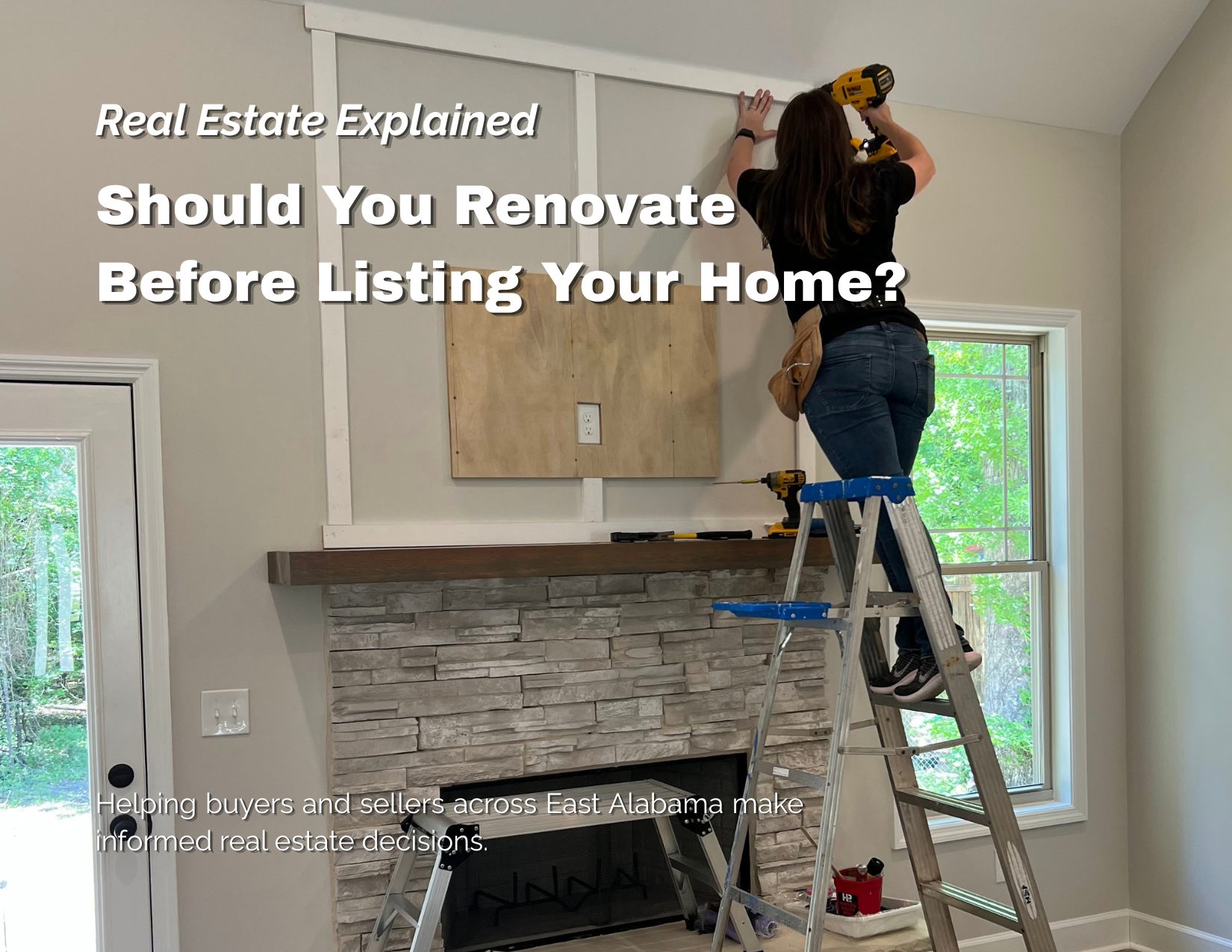
Real Estate Explained
Should You Renovate Before Selling Your Home?
If you’re thinking about selling your home, you’ve probably asked yourself one of the most common questions homeowners face:
“Should I renovate before I list my home?”
The honest answer?
It depends.
Some improvements can help your home sell faster and potentially for more money. Others may cost thousands of dollars without adding much value at all.
So, Before you start knocking down walls or replacing every countertop, here’s what you should know.
Start With the Simple Things
The best return on investment doesn’t always come from major renovations.
Sometimes, the biggest impact comes from making your home feel clean, well-maintained, and move-in ready.
A few simple updates like:
- Fresh paint
- Deep cleaning
- Touch-up landscaping
- Replacing burned-out light bulbs
- Decluttering
- Cleaning windows
can completely change a buyer’s first impression.
Many buyers aren’t looking for perfection, they’re looking for a home that has been well cared for.
Not Every Renovation Pays You Back
One of the biggest mistakes sellers make is assuming every dollar they spend will increase the value of their home.
Unfortunately, that’s not always how it works.
A $40,000 kitchen remodel doesn’t automatically increase your home’s value by $40,000.
In fact, some highly personalized upgrades may actually make it harder for buyers to picture themselves living there.
Instead of asking,
“What do I want?”
ask,
“What will today’s buyers appreciate?”
Every Neighborhood Is Different
The improvements that make sense for one home may not make sense for another.
For example:
A home in one neighborhood may need updated flooring to stay competitive.
Another neighborhood may place more value on outdoor living spaces.
In some cases, buyers expect fully updated homes.
In others, they expect to personalize the home themselves.
That’s why local market knowledge matters.
Focus on Repairs First
Before investing in cosmetic upgrades, make sure the basics are covered.
Buyers notice things like:
- Leaky faucets
- Damaged flooring
- Peeling paint
- Broken door handles
- Loose railings
- HVAC issues
Small maintenance items can create the impression that larger problems have been ignored.
Because of this, fixing these issues first often provides a better return than expensive cosmetic renovations.
Should You Renovate?
Here’s a simple guide.
Renovations that often pay off:
✔️ Fresh neutral paint
✔️ Updated lighting
✔️ Landscaping
✔️ Professional cleaning
✔️ Minor kitchen or bathroom updates
✔️ New hardware and fixtures
Renovations to think carefully about:
- Luxury kitchen remodels
- High-end appliances
- Removing walls
- Custom finishes
- Swimming pools
- Highly personalized upgrades
Every situation is different.
Talk to a REALTOR® Before You Spend the Money
One of the biggest advantages of working with a local REALTOR® is knowing where to invest and where not to.
Before spending thousands of dollars, ask an agent who understands your neighborhood and current buyer expectations.
Sometimes, spending $500 wisely can have a bigger impact than spending $20,000 in the wrong place.
The Bottom Line
Should you renovate before selling your home?
It depends.
The right improvements can absolutely help your home attract buyers and maximize its value.
The wrong improvements can cost time, money, and unnecessary stress.
Before starting your next project, let’s have a conversation about what makes the most sense for your home, your neighborhood, and your goals.
Sometimes the smartest renovation is knowing when not to renovate.
Why Price Per Square Foot Can Be One of the Most Misleading Numbers in Real Estate
Price Per Square Foot – The Most Misunderstood Number In Real Estate
Helping buyers and sellers across East Alabama understand real estate, one question at a time.
“What’s the price per square foot in my neighborhood?”
As Realtors®, this is one of the most common questions we get from homeowners.
It’s an understandable question. Price per square foot is easy to find online, it’s often mentioned in market reports, and it seems like a quick way to estimate what a home might be worth.
In fact, many sellers become attached to that number before we ever sit down to discuss pricing.
The problem is that relying too heavily on price per square foot can create unrealistic expectations. In today’s market, pricing a home based on a simple calculation instead of its true market value can lead to fewer showings, lower offers, and ultimately more time on the market.
Before we talk about why, it’s important to understand what price per square foot actually tells us…and what it doesn’t.
What Is Price Per Square Foot?
Price per square foot is exactly what it sounds like. You take the sale price of a home and divide it by its finished square footage.
For example:
- A home that sells for $400,000 with 2,000 square feet sold for $200 per square foot.
It’s a useful statistic because it helps identify general trends in a neighborhood or local market.
The key word, however, is general.
It’s a market indicator, not a pricing formula.
No Two Homes Are Truly the Same
Imagine two homes that are both 2,000 square feet.
One backs up to a golf course.
The other sits on a busy road.
One has a beautifully renovated kitchen with custom cabinetry and quartz countertops.
The other still has its original finishes from twenty years ago.
One has a screened porch overlooking a private backyard.
The other has no outdoor living space at all.
Even though they’re exactly the same size, they are unlikely to sell for the same price.
Square footage is only one piece of the puzzle.
Smaller Homes Often Have a Higher Price Per Square Foot
This surprises many homeowners.
A 1,400-square-foot home may actually sell for a higher price per square foot than a 3,200-square-foot home in the very same neighborhood.
Why?
Because certain parts of every home carry significant value regardless of size.
Think about the kitchen.
Bathrooms.
The garage.
The roof.
The HVAC system.
The lot itself.
Those costs don’t double simply because the house is larger. Since those fixed-value features are spread across fewer square feet in a smaller home, the price per square foot is often higher.
That’s completely normal.
Buyers Don’t Shop With Calculators (Well, Most buyers anyway)
When buyers walk through a home, they aren’t thinking:
“This feels like exactly $212 per square foot.”
Instead, they’re asking themselves questions like:
- Can I picture my family living here?
- Is the kitchen updated?
- Do I love the backyard?
- Is there enough storage?
- Does the layout work for our lifestyle?
- Is this home worth the asking price compared to others I’ve seen?
Those emotional and practical decisions influence value far more than a simple mathematical formula.
Location Can Change Everything
You’ve probably heard the phrase:
Location, location, location.
There’s a reason it’s still one of the biggest factors in real estate.
Two nearly identical homes can have very different values simply because of where they’re located.
Things like:
- Neighborhood demand
- School districts
- Privacy
- Lot size
- Views
- Nearby amenities
- Traffic patterns
- Future development
all influence what buyers are willing to pay.
That’s true whether the home is in Auburn, Opelika, or one of the many wonderful communities throughout East Alabama.
Appraisers Don’t Use Price Per Square Foot Alone
One of the biggest misconceptions is that appraisers determine value by multiplying square footage by a dollar amount.
They don’t.
Professional appraisers compare similar homes that have recently sold and then make adjustments for differences such as:
- Size
- Age
- Condition
- Updates
- Lot characteristics
- Garages
- Pools
- Outdoor living spaces
- Overall appeal
This process creates a much more accurate picture of a home’s market value than a simple price-per-square-foot calculation ever could.
So… Is Price Per Square Foot Useless?
Not at all.
It’s actually a valuable tool when it’s used correctly.
Real estate professionals use price per square foot to identify market trends and compare similar properties.
The problem comes when it’s treated as the only factor in determining value.
Every home has its own story.
Every neighborhood is different.
Every buyer values different features.
That’s why pricing a home is both a science and an art.
The Bottom Line
Pricing a home isn’t about finding a magic number and multiplying it by the square footage.
It’s about understanding how buyers see your home in today’s market.
A well-priced home often attracts more interest, generates stronger offers, and creates a smoother selling experience.
On the other hand, pricing too high because of an oversimplified price-per-square-foot calculation can cause a home to sit on the market longer than necessary. As time passes, buyers naturally begin to wonder why it hasn’t sold, and that can make achieving your desired price even more challenging.
That’s why I prepare a Comparative Market Analysis (CMA) for every seller. A CMA looks beyond square footage to evaluate the things buyers actually pay for—location, condition, updates, amenities, lot characteristics, and recent comparable sales.
Our goal isn’t simply to tell you what your home is worth.
Our goal is to help you price it strategically so you can attract the right buyers and maximize your opportunity in today’s market.
Have a question you’d like us to explain?
Send it our way! Your question could inspire a future edition of Real Estate Explained. Whether you’re buying, selling, investing, or simply curious about the market in East Alabama, we’re here to help.